Mixing patterns in a room is a fine art. It’s part creativity, part science. If mixing patterns scares you, but you love the look, I have some methods that I use when it comes to decorating our homes.
Tip #1 – Start By Picking Your Color Scheme
If you’re starting from scratch, I like to pick 1-2 colors for the room. Once you’ve nailed these down, it becomes easier to find patterns in those colors. You can sprinkle in a third color to create a more layered look, but to begin, just keep it easy with 1-2 colors.
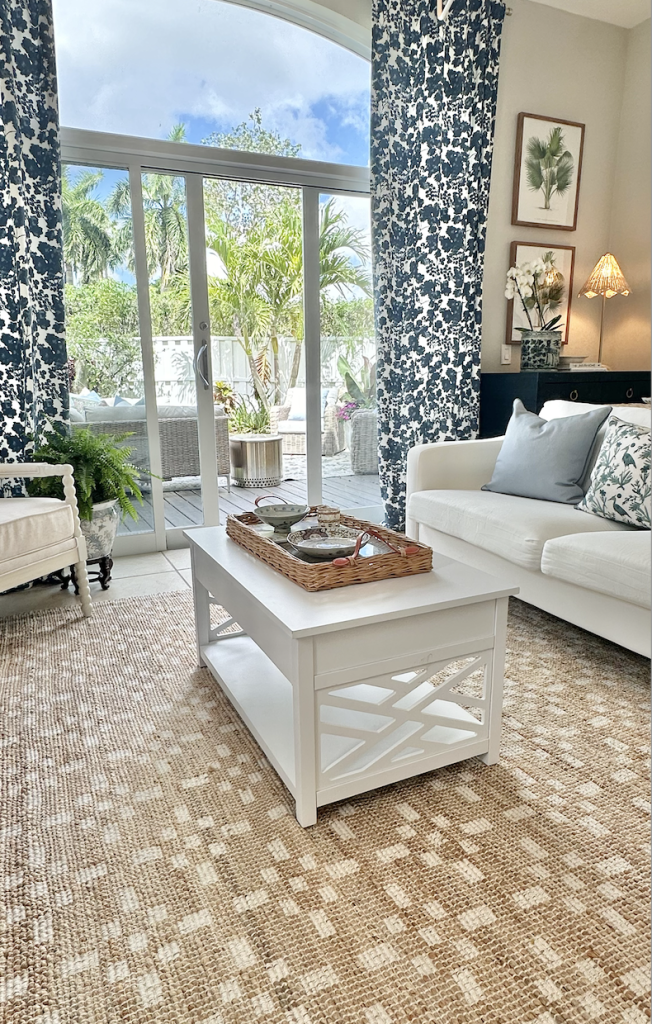
For living rooms, this might mean looking for curtains and rug in your two main colors. In our living room in Florida, my main colors were blue and green, and I broke them up with white furniture and a sisal patterned run. Adding a third color – through wallpaper, lampshades, or an accent pillow, can provide more depth to the room. I think our living room would have looked great with camel grasscloth wallpaper, for instance.
At this point, I completely disregard the room’s paint color. Paint is easy to change, and there are so many color options. It’s a lot harder to find the right curtains or rugs – having them match your current paint complicates it.
Tip #2 – Choose Your Focal Point
Once you’ve nailed down your colors, you can begin shopping for some pieces. If you’re starting from scratch, I would start by finding your couch or bed – whichever is your largest piece in the room. If you’re going with a bold pattern on either of those, they’ll most likely be the focal point of your room and you’ll have to be more subdued elsewhere.
If you’re going more neutral with your large pieces, they you can have more fun with pattern on your wall coverings or curtains.
I think the majority of you will remain neutral with your headboard or couch, so let’s go that route.
Say your couch is a neutral – like a white couch or a solid grey couch – it won’t be as much of a focal point, so you can have fun mixing patterns elsewhere, like on your curtains, on your rug, and on your pillows. You can even layer more pattern with upholstered accent chairs.
With a neutral or solid couch, I would start by finding your curtains in your main color. Keep in mind that the curtains don’t have to incorporate both of your main colors – they can just feature one prominently.
After finding your curtains, I would look for a rug. This can either be in the same color as the curtains or in your secondary color. Rugs can give you the opportunity to saturate the room in more color – or you can use them as a buffer or neutralizer, if you want more pattern and color elsewhere. If you want to neutralize the space, I’d look for a patterned sisal rug, like this one.
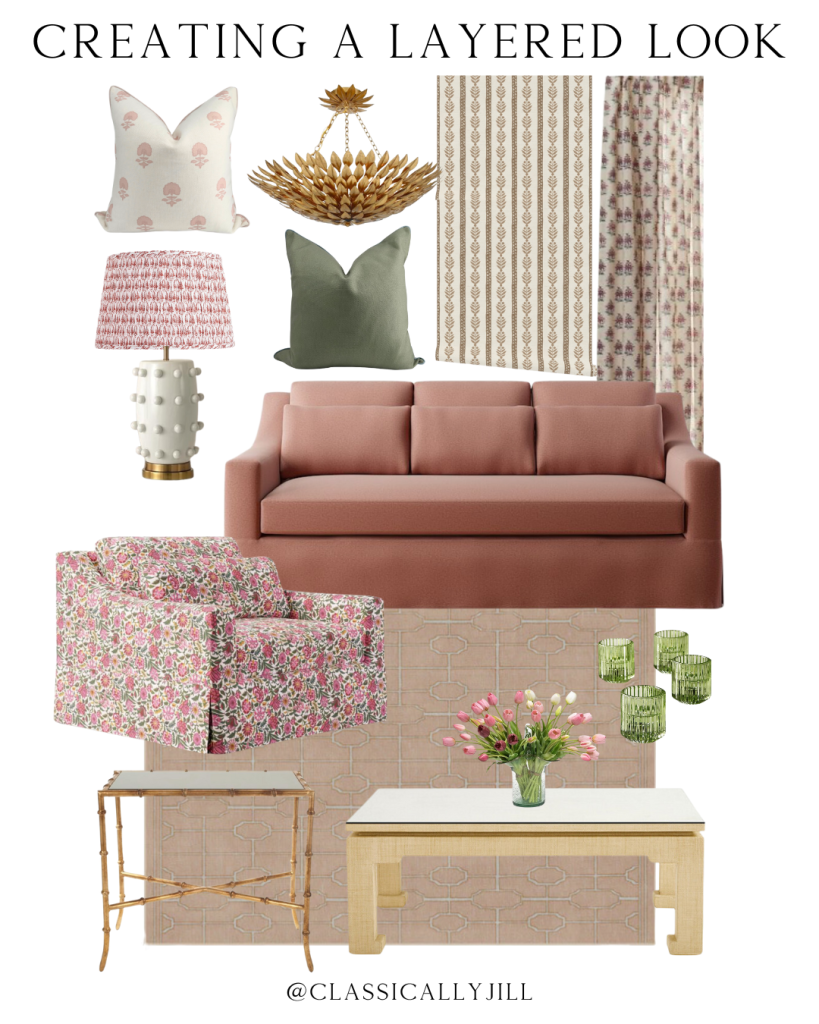
In this design, the mauve rug saturates the room more in raspberry color. It also pulls in the same color as the curtains and couch.
As for patterns, I try to keep the patterns in the same decor style, but I don’t get too in the weeds about shades of colors. IMO, it helps to create a more layered look if things don’t match up perfectly. If we get too exact, that looks like you went to a furniture store and bought an entire matchy-matchy room, IMO.
(As far keeping the same decor style, I mean don’t pair a farmhouse style rug with modern geometric curtains.)
Step 3 – Pick Patterns for Your Layered Decor
In the room design above, my main colors are mauve and cream. I used these for my large pieces: my couch, my curtains, my rug, and my wallpaper.
My third color to accent the space is green. My small accent decor pieces (the votives, pillow, and flowers) add a pop of green to an otherwise rosy palette.
My accent chair has touches of all three colors, which makes it a hero piece that pulls the room together. Accent chairs can be a great way to explode the room with pattern 🙂
Common pattern pairings that I like:
- a floral pattern with a striped pattern
- a large floral pattern with a smaller geometric pattern (think a block print floral pillow on a gingham chair)
- a chinoiserie pattern with a stripe or solid pattern
- a chintz pattern with a medium-size “round” pattern
If that’s the hardest part for you, try to find pillows that look like a “stripe” and others that look more “spotted.” Those two will usually go together well.
Tip #3 – Pay Attention to Your Large Pieces
Large pieces in your room can either serve as the focal point or be the buffers between all the bold patterns. I tend to like the latter – keeping my furniture pieces more neutral – so I can swap out curtains and rugs more easily when I crave a change. That being said, I do love a bold headboard or couch. If you want to design around those bold pieces, go for it! Just remember the 1-2 color rule.
In a bedroom, this might mean starting with your upholstered headboard pattern and finding matching or coordinating curtains in the same color. Then, you can add pillows in your second color and pattern. Lastly, you can use white or neutral bedding and a neutral patterned rug to act as your buffers. For a third pop of color, consider a bold bolster pillow, quilt, or fabric lampshades.
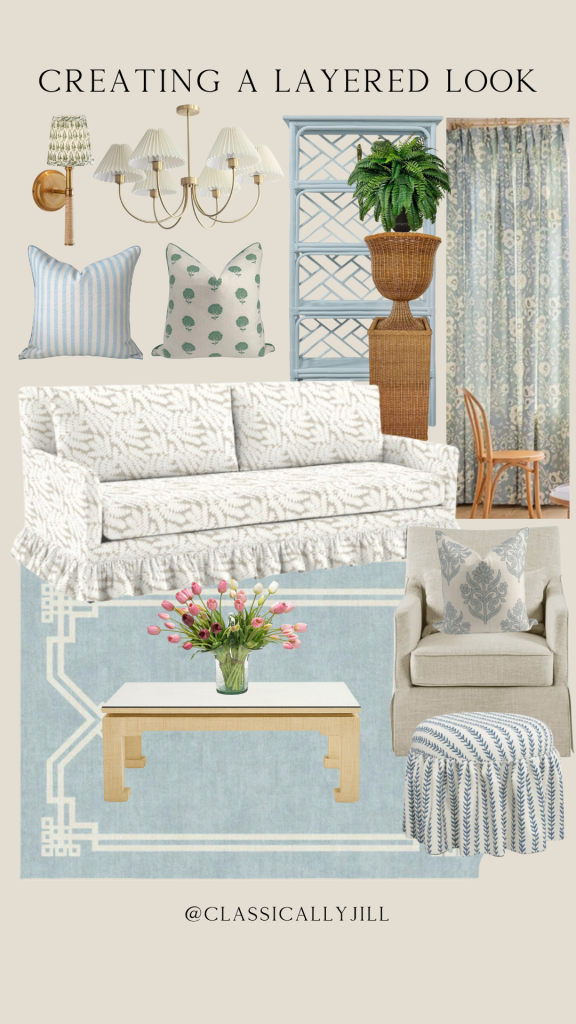
In this design below, I started with the patterned sofa. I thought the pattern’s color and style seemed calm and relaxing, almost like a beach house, so I made the primary colors blue and cream with pops of green.
This couch has a large scale pattern, so it’s important that other bigger pieces in the room also have a larger scale print to balance it out. That’s why I chose these patterned curtains and the larger bordered rug, both in my primary colors.
The pillows also have larger scale prints on them, which layer nicely over the patterned couch. The blues, greens, and creams fit the palette.
I kept the chandelier white and neutral but incorporated some more green with the sconce shades and live plants.
I hope you found these tips useful, if you’re looking to switch up your decor this season!